
The quaich is one of Scotland’s most recognisable traditional drinking vessels.
Often called the “cup of friendship,” it has long been used to share a drink as a gesture of trust, welcome, and goodwill.
Understanding the quaich meaning and the Scottish Quaich tradition helps explain why this simple two-handled cup has remained an important part of Scottish culture for centuries.
Today, quaichs are still used in weddings, celebrations, and ceremonial occasions across Scotland and beyond.
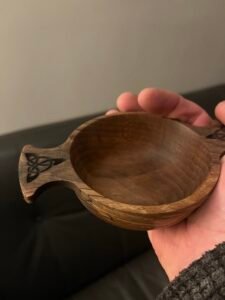
What Is the Quaich Meaning?
The quaich meaning is closely connected with friendship, hospitality, and trust. Traditionally, a quaich was used to offer a drink to a guest or to share a toast among friends. Passing the cup from one person to another symbolised goodwill and mutual respect.
Because of this, the quaich became widely known as the “cup of friendship.” Sharing a drink from a quaich was more than simply drinking—it represented a bond between the people holding the cup.
This meaning continues today, particularly in weddings and family celebrations where the act of sharing a drink symbolises unity.
The Origin of the Word Quaich
The word quaich comes from the Scottish Gaelic word “cuach,” meaning cup. Over time, the spelling evolved as Scots and English became more widely used in Scotland.
Historical examples of quaichs date back several centuries. Early examples were often carved from hardwoods such as sycamore or other native timbers. These wooden cups were practical for everyday use and were commonly found in Highland households.
Later, quaichs were also produced in materials such as horn, pewter, and silver. Despite these changes in materials, the basic design remained consistent, helping preserve the Scottish Quaich tradition across generations.
Why Does a Quaich Have Two Handles?
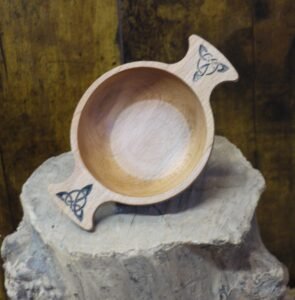
One of the most distinctive features of a quaich is its two
shallow handles, traditionally called lugs.
These handles served a practical and symbolic purpose. When
accepting a drink from a quaich, the person would hold it using both handles.
This meant both hands were visible, demonstrating that they carried no weapon
and symbolising trust between host and guest.
The handles also made it easy to pass the cup from one
person to another during gatherings. This encouraged sharing and reinforced the
social nature of the Scottish Quaich tradition.
Because of this design, the quaich naturally became
associated with hospitality and friendship.
The Scottish Quaich Tradition in Ceremonies
Although the quaich began as a practical drinking vessel, it gradually became associated with ceremonial and symbolic occasions.
Today, the Scottish Quaich tradition is commonly seen in several types of events:
Weddings
Many couples share a drink from a quaich during their wedding ceremony. This act symbolises the joining of two families and the beginning of a shared life together.
Clan Gatherings
At clan events and Scottish heritage celebrations, a quaich may be passed among participants to represent unity and shared history.
Welcoming Guests
Offering a drink from a quaich can be a symbolic gesture of hospitality, continuing the tradition of welcoming visitors with warmth and goodwill.
Awards and Commemorations
Quaichs are often given as presentation pieces to recognise achievements, retirements, or special milestones.
In each case, the symbolism remains connected to the traditional quaich meaning—friendship, trust, and shared celebration.
Why the Quaich Remains an Important Scottish Symbol
Despite changes in materials and manufacturing, the basic design and purpose of the quaich have remained remarkably consistent. Its shallow bowl and two handles continue to represent openness and trust.
Today, handcrafted wooden quaichs, engraved quaichs, and ceremonial silver quaichs are used across Scotland and internationally by people who wish to celebrate Scottish culture and tradition.
For many, the quaich meaning still reflects the same values it did centuries ago: hospitality, friendship, and the sharing of good company.
Conclusion
The Scottish Quaich tradition has endured because it represents something simple yet powerful—the act of sharing a drink as a sign of friendship and welcome.
From its Gaelic origins to its role in modern ceremonies, the quaich remains a meaningful symbol of Scotland’s culture. Whether used in weddings, family gatherings, or as a commemorative gift, the quaich continues to carry forward the timeless quaich meaning of trust, hospitality, and friendship.